


Bearing ring blanks are roughly divided into the following five types: (1) forgings; (2) pipes; (3) bars (for direct cutting); (4) coils; (5) plates and strips.
Radial ball bearings and tapered roller bearings mostly use forgings. The reasons for using a large number of forgings are: (1) The ductility of the metal is used to form the required size and shape, which reduces the cutting allowance. In addition, it can apply high-speed processing machines such as punching machines and rolling machines, and the productivity is high. (2) If the shear processing surface of the bar, pipe, and plate and the bottom exhaust during processing are removed, the metal flow line of the product will not be cut off. In addition, the material strain makes the grains finer, and the work hardening improves Material strength, etc., can improve the performance of the material itself. In addition, large-diameter bearings used in wind turbines and industrial machinery must use forgings.
As for small-diameter products produced in small batches, sometimes the advantages of forgings cannot be used in terms of cost. At this time, pipes and bars can be used.
1 Radial ball bearings, tapered roller bearings
The forging of the inner and outer rings of radial ball bearings has the following methods: high temperature forming + cold rolling; hot forging + hot rolling; hot forging + cold rolling, etc.
1.1High temperature forming + cold rolling
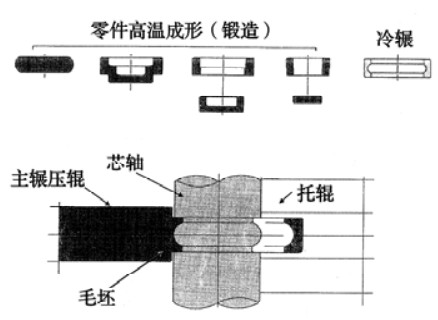
Figure 1 is a schematic diagram of high temperature forming + cold rolling of parts. The bearing steel bar is used as the raw material, heated by high frequency, and then cut into a specified length in the high-temperature forming machine of the part, and the annular blank of the inner ring and the outer ring is forged, then spheroidized annealed, shot peened, and finally cooled. Rolling processing. According to the workpiece size, the production speed of high temperature forming is 100~180 pieces/min, and the number of cold rolling equipment required should match it. The high-temperature forming equipment is basically a horizontal multi-process pressure forging machine, with a punch on the side of the slider (press head) and a forging die on the fixed side (press backing plate), and the material is forged between the metal dies.
1.2 Hot forging + hot rolling
The raw material (blank) of the medium-sized bearing ring that exceeds the high-temperature forming processing capacity of the part is processed by the process in Figure 2. The bar is cut off by shearing or machining to form a billet, the billet is heated, and the ring-shaped blanks of the inner ring and the outer ring are manufactured with a large vertical forging press, and hot rolling is carried out by using the waste heat. Then, spheroidizing annealing, shot peening, and outer diameter finishing (shaping) are performed.
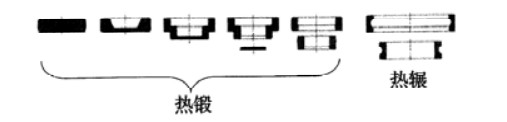
This processing method carries out forging and rolling processing at the same temperature, so the thermal efficiency is high, the deformation resistance is small, and the process cycle is shortened. However, due to the direct connection of the two processes, the operating rate of the equipment is reduced. At the same time, in order to match the forging cycle with the rolling cycle, the cycle time has to be set downward, so the ability of the forging process cannot be fully utilized, and this method is not effective. promote.
1.3 Hot forging + cold rolling
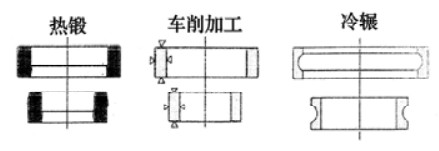
Hot forging produces ring-shaped blanks, after cooling, spheroidizing annealing and shot peening are carried out, and then cold rolling is carried out. The production speed of hot forging is lower than that of high temperature forming (section 1.1), but it has good versatility and it is easier to develop metal molds. The working pressure of the cold rolling process is higher than that of the hot rolling process. The processing time is long, but the cold rolling process does not require the tedious temperature management of the billet as hot rolling does. Because it is easy to handle blanks, it is easy to realize production automation, and the product precision is also high. As shown in Figure 3, before cold rolling, turning is performed to form a high-precision blank. After cold rolling, the turning process is omitted, and after heat treatment, only grinding is performed to obtain finished parts with high precision end faces, outer diameter surfaces, and inner diameter surfaces.
1.4 Hot forging + cold forging
The ring-shaped blank is manufactured by hot forging, and after spheroidizing annealing, turning, and shot blasting, the phosphating-treated blank is cold-forged. In this case, the size of the parts that can be processed is limited, but it is easy to improve the accuracy. In addition, if ball annealing is performed, due to surface decarburization, processing to eliminate the decarburization layer is required. However, it has been proposed that complex carbon annealing reduces the turning allowance process.
1.5 Summary
The factory for forging bearing ring blanks is developing in the direction of specialization and automation. By further improving the life of the metal mold, the miniaturization of the metal mold, and improving the operability, the production efficiency has been greatly improved. With the advancement of sensor technology, the monitoring of processing status and metal mold status has been continuously improved, which can further reduce the defective rate. In addition, in order to reduce the burden on the environment, increase the pass rate of products, and reduce the processing burden in subsequent processes; the miniaturization and energy saving of production equipment; the use of more environmentally friendly white lubricants, etc., are also receiving more and more attention.
2 Radial needle roller bearings
Needle roller bearings are often used in transmissions, engines, and compressors, where the installation space of the bearings is narrow and a large load-carrying capacity is required.
The processing and forming methods of the outer ring of the radial needle roller bearing include: (1) stamping of the plate; (2) cutting of the forging blank; (3) cutting of the pipe, etc. Among them, the stamping processing of sheet metal accounts for the absolute majority. The reason is that needle bearing parts are thinner than ball bearing parts and are suitable for stamping.
According to the processed product shape, size, batch, etc., you can choose to adopt the continuous automatic stamping processing method, or choose the continuous processing method. 3 Thrust needle roller bearings
Thrust needle roller bearing rings are almost always made by stamping. The processing method is usually the continuous automatic stamping processing method described in Section 2.2. Due to the thin thickness of the product, the number of processing steps is less than that of the outer ring of the radial needle roller bearing, but the flatness is very important, and the stamping process, process and metal mold shape should be considered. In addition, the rings of the thrust needle roller bearings are difficult to press to improve the surface roughness of the rolling surfaces that come into contact with the rollers. Therefore, it is very important to use the blank with good surface roughness and maintain the processing method of its surface state. It should be carried out in many aspects such as material supply (feeding) device, forming process, transmission in the stamping machine, product delivery, and even the treatment of subsequent processes. Careful consideration.
(Source: Bearing Magazine)
Awesome! Share to:
Get in Touch
*We respect your confidentiality and all information are protected.